Property Site Plan vs. Official Property Survey: Understanding the Benefits, Costs, and Trade-offs
- Sep 23, 2025
- 2 min read
Updated: Oct 18, 2025
When starting a residential or commercial project—whether it’s adding an ADU (Accessory Dwelling Unit), installing a pool, or planning a full renovation—two key terms often come up: Property Site Plan and Official Property Survey. While they sound similar, they serve different purposes, carry different costs, and provide unique benefits depending on the stage of your project.
In this blog, we’ll break down:
What a Property Site Plan is
How it compares to an Official Property Survey
The cost benefits of using a site plan first
Pros and cons of both approaches
When you need one vs. the other

What is a Property Site Plan?
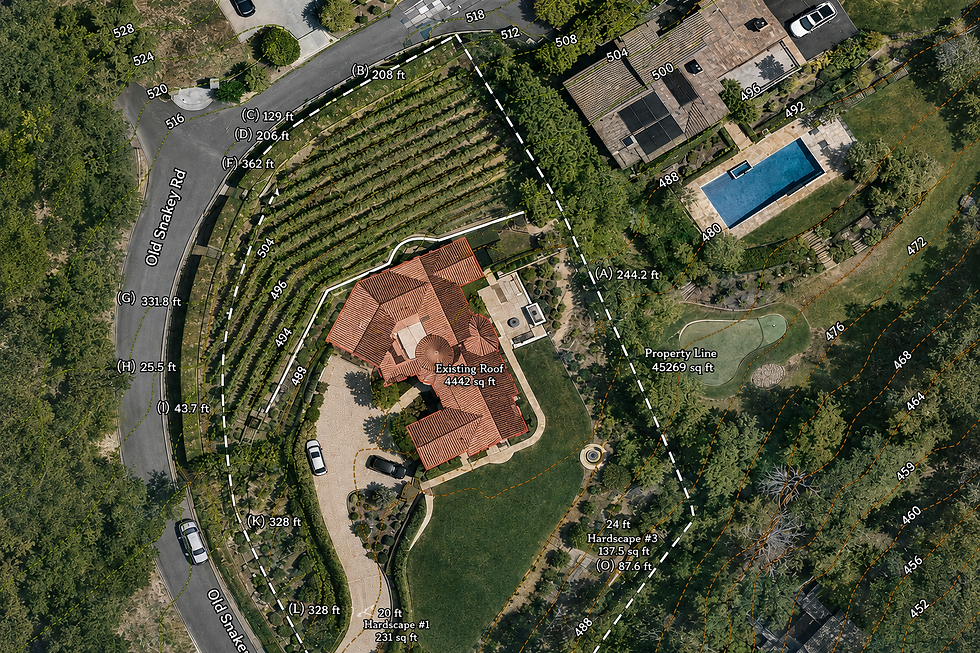
A Property Site Plan is a scaled drawing that shows existing conditions of your property (boundaries, structures, landscaping, driveways, pools, utilities, etc.) along with proposed improvements.
Modern platforms like InQI.AI can automatically generate preliminary site plans in seconds using your property address, aerial imagery, topographic data, and local building codes.
Typical uses of a Site Plan:
Early-stage design and feasibility analysis
Exploring placement of new structures (e.g., ADU, garage, pool)
Checking zoning setbacks, utility conflicts, and sun orientation
Providing visuals for clients, HOAs, or planning departments
Key Advantage: A site plan can be generated quickly and at a fraction of the cost of a professional land survey.
What is an Official Property Survey?
An Official Property Survey is prepared by a licensed land surveyor. It involves physically measuring the land to confirm property boundaries, easements, encroachments, and elevations.
Typical uses of a Survey:
Legal verification of property boundaries
Resolving disputes with neighbors
Supporting mortgage, title, or insurance requirements
Submittals where the city or county mandates a stamped survey
Key Advantage: A survey is legally binding and recognized by municipalities, lenders, and courts.
Cost Benefits: Site Plan vs. Survey
Property Site Plan:
Cost: Often between $250 – $1,000, depending on project scope. AI-driven platforms can generate them in minutes at even lower costs.
Timeline: Instant to a few days.
Official Property Survey:
Cost: Typically $1,500 – $5,000+ depending on property size, complexity, and region.
Timeline: Several days to weeks, depending on surveyor availability.
Takeaway: A site plan is far more affordable and faster, making it the right tool for early-stage planning. A survey should be reserved for legal or compliance-critical steps.
Pros and Cons
Factor | Property Site Plan | Official Property Survey |
Speed | Generated in minutes (AI or CAD tools) | Days to weeks |
Cost | Low ($250–$1,000) | High ($1,500–$5,000+) |
Detail | Includes existing + proposed improvements | Confirms boundaries, easements, elevations |
Legal Standing | Not legally binding | Legally recognized |
Best Use | Early feasibility, design iterations, HOA presentations |
When Should You Use Each?
Use a Property Site Plan when:
You’re exploring design concepts or feasibility
You want quick visuals for clients or HOA review
You need to test compliance with zoning and setbacks before spending on surveys
Use an Official Survey when:
City/county requires it for permits
You’re financing or selling the property
Boundary disputes or easement issues are involved