🏡 What Is a Site Plan: Definition, Elements, and Examples
- Sep 25, 2025
- 3 min read
Updated: Oct 18, 2025
A site plan is one of the most fundamental documents in architecture, engineering, and construction (AEC). Whether you’re building a backyard deck, adding a swimming pool, designing an Accessory Dwelling Unit (ADU), or planning a commercial project, the site plan is often the first official drawing a city, HOA, or contractor will ask for.

But many people don’t know what a site plan actually is—or how it differs from a property survey. Let’s break it down in detail.
📌 Definition: What Is a Site Plan?
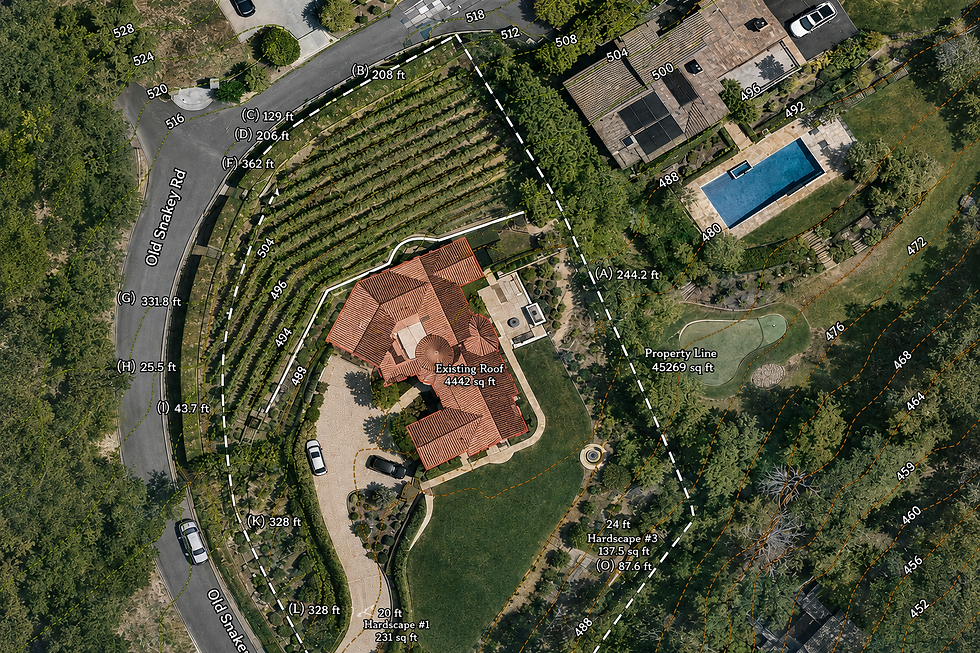
A site plan Example is a scaled drawing of a property that shows existing and proposed features on the land. Unlike a legal property survey (which establishes official boundaries through field measurement), a site plan is a visual representation of how the property will be used or modified.
It typically includes:
Property boundaries (pulled from GIS, assessor’s records, or surveys)
Placement of structures (home, garage, sheds, ADUs)
Landscape features (trees, fences, patios, driveways)
Utilities, easements, and access points
Proposed changes (new construction or modifications)
🧩 Key Elements of a Site Plan
While the exact requirements vary by city or HOA, most site plans include the following elements:
1. Property Lines
Defines the legal perimeter of your lot.
Pulled from public records or surveys.
Usually shown as a rectangle or irregular polygon with dimensions noted.
2. Structures
Shows the footprint of the main house and any existing accessory structures (garage, sheds, pergolas, pools).
3. Driveways, Walkways & Access Points
Important for vehicle access, fire department review, and drainage considerations.
4. Landscaping & Natural Features
Trees, gardens, slopes, retaining walls, streams, or other natural conditions.
Helps in planning for drainage or setback requirements.
5. Utilities & Easements
Water, sewer, electrical lines, and shared access paths.
Some cities require easements to be clearly shown before granting permits.
6. Proposed Changes
This is the “what’s new” layer—whether you’re adding a deck, fence, ADU, or pool.
Cities use this to check code compliance (e.g., setbacks, lot coverage).
HOAs use this to check aesthetics and neighborhood consistency.
⚖️ Site Plan vs. Property Survey
A survey is a legal document done by a licensed land surveyor. It’s precise and can be used in disputes, sales, or court. A site plan, on the other hand, is usually sufficient for permits and planning, and much faster and cheaper to produce.
Feature | Site Plan | Property Survey |
Purpose | Planning, permitting, design | Legal property boundaries |
Prepared by | Draftsmen, architects, online services | Licensed surveyor |
Cost | $150–$500 (online) | $2,000+ (fieldwork) |
Speed | Hours to days | Weeks |
Legal Use | NOT legally binding | Legally binding |
🛠 Examples of When You Need a Site Plan
Building a Deck or Patio – The city will ask for a site plan to check setbacks.
Installing a Pool or Spa – The site plan must show pool location, fencing, and safety features.
ADU or Garage Addition – Permits require showing how the new building fits into the lot.
HOA Review – Homeowners associations often request a site plan before approval.
Contractor Bidding – Builders use site plans to estimate grading, access, and scope.
🚀 How InQI Is Transforming Site Plans
Traditional site plans (like those offered on services) are static drawings. They’re useful—but limited. InQI takes this concept further by using AI to create living, intelligent site plans:
Address-Based Automation – Just enter your property address, and InQI pulls aerial imagery, topography, zoning, and codes automatically.
AI-Generated Preliminary Site Plans – InQI instantly creates a baseline site plan that reflects the real conditions of your lot.
Natural Language Input – Instead of hiring a draftsman, you type: “Design a 500 sqft modern ADU with a loft in the backyard.” InQI produces site plan + design concepts in minutes.
Code Compliance – Integrated with local building codes (via binders), InQI checks setbacks, FAR (floor area ratio), and height limits as you design.
Construction Handoff – Unlike a static PDF, InQI site plans flow directly into cost estimating, permitting, and construction documentation.
🌟 The Future of Site Planning
As we look ahead, the role of site plans will continue to evolve. With advancements in technology, we can expect even more innovative solutions. Imagine being able to visualize your project in 3D before breaking ground. This will not only enhance creativity but also streamline the entire process.
🎯 Conclusion
A site plan is more than a drawing—it’s the foundation of any project. While traditional providers can get you quick, affordable plans, tools like InQI elevate the process by combining data, AI, and compliance in one seamless platform.
Instead of just seeing “what’s on your lot,” InQI helps you design what’s possible—smarter, faster, and code-compliant from the start.